By the Optima Payroll Team
Every Kenyan payslip in 2026 carries four statutory deductions: PAYE, NSSF, SHIF and the Affordable Housing Levy. Two changes in the past two years altered how they interact. NSSF limits rose again in February 2026. And since December 2024, SHIF and the Housing Levy have been deducted before PAYE is calculated, which lowers employees' tax. Payroll systems that were not updated are still over-taxing staff.
Here are the current rates, a worked example, and the errors we see most often.
The 2026 Statutory deduction rates at a glance
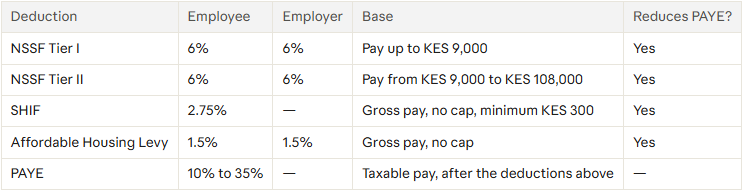
The most an employee pays in NSSF is KES 6,480 a month: KES 540 in Tier I and KES 5,940 in Tier II. The employer matches it. These are Year 4 limits under the NSSF Act 2013, in force since 1 February 2026.
PAYE bands for 2026
The Finance Act 2026 did not change the PAYE bands or personal relief.
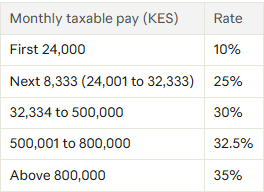
Personal relief is KES 2,400 a month for resident employees, deducted from the tax calculated.
A worked example of a Kenyan employee earning a gross pay of KES 100,000
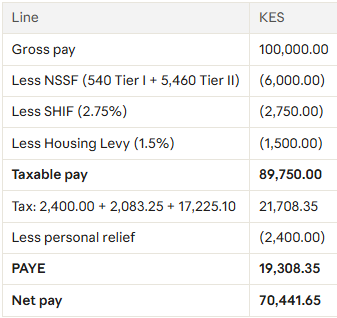
The employer's cost is gross pay plus the employer's NSSF (KES 6,000) and Housing Levy (KES 1,500), about KES 107,500 before the NITA levy.
Recent changes in Kenyan statutory deductions laws and when
- 27 December 2024: the Tax Laws (Amendment) Act 2024 made SHIF and Housing Levy contributions deductible before PAYE. It removed the old 15% affordable housing relief. Post-retirement medical fund contributions became deductible up to KES 15,000 a month, and pension contributions up to KES 30,000 a month.
- 1 February 2026: NSSF Year 4 limits took effect. The lower limit rose from KES 8,000 to 9,000, and the upper limit from KES 72,000 to 108,000.
- 1 July 2026: the Finance Act 2026 capped tax-exempt gratuity. It must come from a contract of at least three continuous years and not exceed 31% of the employee's emoluments for that period.
- From 1 January 2027: individuals file their annual income tax returns by the last day of the fourth month after the year ends, which is 30 April for calendar-year taxpayers, under KRA's Finance Act 2026 guidance.
The seven payroll errors that cost employers most
- Calculating PAYE before deducting SHIF and the Housing Levy, a common error in older payroll software.
- Using last year's NSSF limits after February.
- Missing the 9th: PAYE is due by the 9th of the following month. Late payment attracts penalties and interest.
- Untaxed benefits: cars, housing, school fees and loans at below-market rates are taxable benefits. Tax-free non-cash benefits are capped at KES 60,000 a year since December 2024.
- Treating staff as "consultants" to avoid PAYE. KRA looks at the substance of the relationship.
- Gratuity over the cap, wrongly treated as exempt after the Finance Act 2026.
- Payroll and returns out of step: KRA cross-checks PAYE returns with employees' own returns and other data.
Payroll and eTIMS: what's exempt
Salaries and wages subject to PAYE are exempt from eTIMS invoicing. But anyone you pay outside payroll, such as a casual labour contractor, trainer or freelancer, falls under the normal eTIMS rules. If they don't invoice through eTIMS, the cost may be disallowed. Read more in our eTIMS guide.
Frequently asked questions
Is the Housing Levy tax-deductible in 2026? Yes. Since 27 December 2024, the employee's Housing Levy contribution is deducted before PAYE is calculated. The earlier 15% relief no longer applies.
Does SHIF have a maximum? No. SHIF is 2.75% of gross pay with no upper cap, and a minimum of KES 300 a month.
Do I deduct NSSF on pay above KES 108,000? No. NSSF contributions stop at the upper earnings limit of KES 108,000.
How Optima Accounting team can help
Optima Accounting and Advisory is a reputable accounting firm in Nairobi. We run payroll for SMEs, NGOs and professional firms, from pay calculation to filing PAYE, SHIF, NSSF and Housing Levy returns on time.
Talk to Optima Accounting & Advisory about outsourced payroll services in Kenya. Book a Statutory Compliance Review, and we will check the compliance status of your payroll management system against the 2026 rules.
Have a question about this?
Our accountants can look at your specific situation.