
Payroll is the function responsible for compensating employees for services rendered within a specified period of time. This is a critical function since for many organizations, salaries and wages form the largest expense and thus is requires working Internal Controls to prevent errors and fraud. Payroll also attracts numerous Tax Audits and Verification exercises as KRA Officials seek to confirm employers’ compliance with relevant statutory obligations. Payroll information is also quite confidential and requires proper management to avoid data leaks or unauthorized access.
Payroll management involves the following:
- calculating employee earnings
- calculating statutory and other deductions
- paying employees
- filing necessary statutory returns
- remitting statutory deductions to various agencies
- payroll reporting and analysis
- maintaining relevant payroll documents
- providing information during external audits, internal reviews and tax audits
Payroll Records and Documents to be maintained in Kenya
In payroll management, employers need to maintain documents relevant to the employees’ earnings and deductions. These include:
- Employment letters
- Salary adjustment letters
- Resignation letters
- Approved overtime forms
- Loan deduction forms
- Mortgage interest and insurance policy certificates
- Valid Tax Exemption Certificates for Persons with Disabilities
Payroll Processing
This is the task of computing employee earnings, deductions, and net amount payable.
Due to the bulk nature of payroll information, it is important for organizations to automate payroll processing and utilize payroll systems to enhance accuracy in the process. There are various payroll systems within the Kenyan market, both desktop and web based, that employers can utilize to automate their payroll processing.
For SMEs with few employees, payroll processing can be done on excel with the necessary internal controls being put in place to avoid data loss or unauthorized access.
Employee Payroll Earnings
This is total compensation earned by an employee which is paid by the employer for services rendered during a specified period.
Employee earnings include:
- Basic Salary
- Wages
- Overtime pay
- Commissions
- Bonus
Payroll Statutory Deductions in Kenya
Statutory deductions are deductions that employers are mandated by law to deduct from employees’ paychecks. Deductions of these statutory deductions and emitting to the relevant government agencies is mandatory, not optional.
These are:
- Pay As You Earn (PAYE) – Income Tax
- National Social Security Fund (NSSF) – Retirement Fund
- National Hospital Insurance Fund (NHIF) – Hospital Insurance
- Higher Education Loans Board (HELB) – Student Loans
- National Industrial Training Authority (NITA) – Training Levy*
*NITA Training Levy is not deductible from the employee but is paid by the employer at the rate of Kes 50 per employee per month.
Statutory Deductions Deadlines in Kenya
Employers are expected to remit statutory deductions and file returns by the dates below:
- PAYE – By 9th of the following month
- NHIF – By 9th of the following month
- NSSF – By 9th of the following month
- HELB – By 15th of the following month
- NITA – By 5th of the following month
Late filing, late payment, or failure to deduct and remit statutory deductions is deemed an offense in Kenya and employers are held responsible and subjected to hefty fines. All Kenyan employers should be aware that any statutory deductions not deducted from employee paychecks are recoverable from the employers with penalties and interest.
Employee Payslips
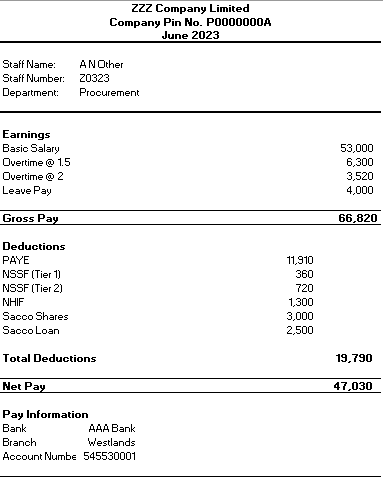
A payslip is a document issued by an employer to an employee indicating the earnings, deductions and net amount payable for a given period. Below is a Sample Payslip with Kenyan Employment Taxes and Statutory Deductions.
Payroll Analysis
This is the process of analyzing payroll information to gain business insights, detect errors and avert possible fraud.
Payroll analysis may include:
- Review of salary fluctuations month on month
- Actual staff cost vs budget variance analysis
- Staff Turnover review
- Head Count per department or business unit
- Revenue and profit per employee
- Attendance, absenteeism and overtime hours worked review
Payroll Compliance Audits in Kenya
This is a review of an organizations payroll systems, processes, internal controls and documentation to verify the integrity of the overall payroll management, identify gaps and suggest possible remedies.
A compliance check involves:
- Review of accuracy in calculation of earnings and deductions
- Payroll cost entries in the general ledger
- Compliance with Tax and Statutory Regulations on deductions, returns and payments
- Review of Payroll Internal Controls and compliance with organizational Processes, Policies and Procedures
- Review of the Payroll Documentation and Record Keeping Systems
About Us: Optima Accounting Services Limited is an Accounting Firm in Nairobi offering Bookkeeping, Accounting, Tax, Payroll, Audit and Training Services to organizations in Kenya.
We are working with employers in Kenya to enhance Payroll Processing, Internal Controls and Compliance through our Outsourced Payroll Processing, Internal Controls Audit, Tax Compliance Audit and Training Services.
For more information reach out on info@optima-accounting.co.ke or Call/SMS/Whatsapp 0700 053980.
Visit our website https://optima-accounting.co.ke/blogs/ to learn more on Financial Management, Tax and Compliance.
Have a question about this?
Our accountants can look at your specific situation.