Mastering the Accounting Period Close: A Practical Guide for Finance Teams and Business Owners

Closing the books at the end of a financial period can be one of the most stressful tasks for accounting and finance teams—especially if processes are manual, fragmented, or unclear.
Whether you're closing monthly, quarterly, or annually, a structured accounting period close process is crucial for ensuring accuracy, compliance, and insightful financial reporting.
In this edition, we break down the close process into clear steps and share practical tips to help you simplify and streamline your workflow.
Your business reports a profit for the month, yet there is barely enough cash to pay suppliers. Is the money tied up in unpaid customer invoices? Did inventory purchases absorb the cash? Were supplier costs left out of the accounts?
Each answer calls for a different decision. A well-run accounting period close gives owners and finance teams the evidence to work out what happened before they commit to new spending, draw on an overdraft or chase the wrong problem.
For SMEs in Kenya, the month-end close is also a chance to bring together records that often sit in different places: the accounting system, bank statements, M-Pesa tills, point-of-sale systems and eTIMS invoices. The value comes from reconciling those records and explaining what the figures mean for the business.
What is an accounting period close?
An accounting period close is the process of completing, reconciling and reviewing financial records for a defined period before issuing reports. Businesses can close their books monthly, quarterly or annually. A monthly close gives management a regular basis for reviewing profitability, cash flow and working capital.
A useful close answers three questions:
- Completeness. Have we captured the income, costs, assets and liabilities that belong in the period?
- Accuracy. Can we support the balances and explain significant changes?
- Action. What should management do based on the results?
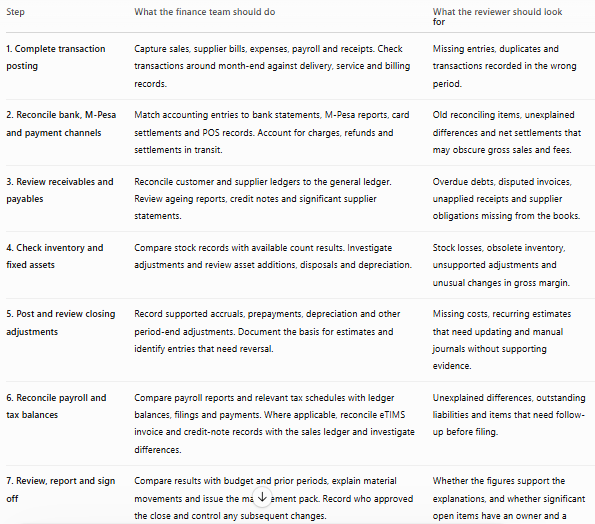
A practical month-end close checklist
How one missed accrual can change a business decision
Consider a Nairobi wholesaler with monthly sales of KES 5 million and recorded cost of sales of KES 3.5 million. Its initial report shows a gross margin of 30%.
During the close, the finance team finds that KES 300,000 in distribution costs directly attributable to goods sold that month has yet to be billed. Assuming the business consistently classifies those costs in cost of sales, the accrual reduces reported gross profit from KES 1.5 million to KES 1.2 million. Gross margin falls to 24%.
That six-percentage-point difference changes the discussion about pricing and discounts. It also matters for cash planning. The cost belongs in the month’s results, while the expected payment belongs in the cash flow forecast.
This is where a disciplined close earns its time. Management can review pricing using a fuller picture of the cost of serving customers and plan for the payment before it falls due.
What should a month-end management report include?
A business owner should be able to open the management pack and see how the business performed, where cash is committed and what needs a decision. For many SMEs, a concise pack includes:
- Profit and loss statement with actuals against budget and explanations for significant variances.
- Balance sheet with commentary on movements in debtors, inventory, supplier balances and borrowings.
- Cash flow summary and forecast showing major expected receipts, payments and potential funding gaps.
- Receivables and payables ageing showing priority collections, overdue accounts and upcoming commitments.
- Action log assigning an owner and due date to each decision or follow-up item.
Make the commentary specific enough to act on. “Gross margin fell by six percentage points” describes the movement. “Higher distribution costs reduced gross margin, and the commercial team will review delivery charges before the next pricing cycle” gives management a decision to follow through on.
How to close the books faster without weakening review
Start by moving routine work into the month. Weekly bank and M-Pesa reconciliations are easier to resolve while receipts and settlement records are still easy to trace. Regular follow-ups on missing supplier invoices also give the finance team time to estimate costs before reporting.
Then agree on a close calendar. An SME with current bookkeeping might use the first two working days for transaction posting and cut-off, the next two for reconciliations and adjustments, and the fifth for review and reporting. Set the timetable around transaction volume, available records and reviewer capacity.
Give each task a preparer, a reviewer and a deadline. Track unresolved items in one place. If an item could materially change the reported result, agree on how to resolve it before sign-off or clearly explain its potential impact in any provisional report. After issuing the pack, document and approve subsequent changes so management can identify which version it relied on.
Frequently asked questions
What is the difference between month-end and year-end close?
A month-end close supports regular management reporting. A year-end close builds on that work and typically involves more extensive checks, including year-end estimates, financial statement disclosures and preparation for an audit where applicable. Consistent monthly reconciliations give the year-end team a clearer record of how balances developed.
Who should review the month-end close in a small business?
Assign someone who can challenge the figures and follow up on exceptions. This might be a finance manager, business owner or outsourced finance lead. Where staffing is limited, prioritise a separate review of cash reconciliations, material manual journals and significant estimates.
What should business owners ask at the close review?
Start with three questions. What changed in profitability? Where is our cash tied up? What decision do we need to make this month? Ask for the figures behind each answer and assign ownership for any agreed action.
Put your monthly accounts to work
If your accounts arrive too late to guide decisions, start with the balances management relies on most. Give cash, receivables, supplier obligations and margin a regular review date. Track the decisions that follow and revisit them at the next close. That is how monthly reporting becomes part of running the business.
Need support with your month-end close? Optima Accounting & Advisory helps businesses in Kenya set up close calendars, strengthen reconciliations and prepare monthly management accounts. Contact us to discuss your current reporting process and where it can improve.
Have a question about this?
Our accountants can look at your specific situation.