Setting Up a Company in Kenya: A Strategic Guide for Foreign Investors
Company registration in Kenya for foreigners, investing in Kenya, doing business in Kenya, Kenya market entry services

By Optima Accounting & Advisory | Business Advisory & International Market Entry
Kenya continues to position itself as one of Africa's strategic investment destinations, offering international businesses access to an expanding consumer market, a technologically innovative economy, a skilled workforce and opportunities across East Africa.
From technology, manufacturing and renewable energy to financial services, logistics, agriculture and professional services, Kenya presents significant opportunities for international investors seeking growth beyond their domestic markets.
However, successfully setting up a company in Kenya requires more than obtaining a Certificate of Incorporation. It requires a comprehensive understanding of the country's regulatory environment, taxation framework, operational costs and financial management requirements.
For foreign investors, the fundamental question should not simply be: How do we register a company in Kenya?
It should be: How do we establish a compliant, financially sustainable and scalable business in Kenya?
1. Why invest in Kenya?
Kenya offers several strategic advantages for international businesses seeking to establish an African presence.
Strategic access to regional markets
Kenya provides a platform for businesses seeking to access the East African Community (EAC), the Common Market for Eastern and Southern Africa (COMESA) and the broader African Continental Free Trade Area (AfCFTA), subject to applicable trade and origin requirements.
Nairobi serves as a regional commercial hub for numerous multinational companies and international organizations.
A growing digital economy
Kenya's established mobile payment ecosystem, fintech innovation and digital infrastructure create opportunities for businesses in technology, e-commerce, financial services and digitally enabled industries.
Access to skilled human capital
International businesses can access a diverse pool of professionals in technology, engineering, accounting, financial services and business administration.
Diverse investment opportunities
Foreign investors can explore opportunities in:
- Manufacturing and industrial development
- Renewable energy and sustainable infrastructure
- Information technology and software development
- Agriculture and agro-processing
- Logistics and distribution
- Real estate and construction
- Healthcare and wellness
- Professional and business support services
The opportunity lies not only in serving the Kenyan market but also in using Kenya as a strategic base for regional expansion.
2. Can a foreigner own 100% of a company in Kenya?
Yes. Foreign investors can generally establish and own 100% of a private limited company in Kenya.
There is no general requirement for a Kenyan citizen to hold shares in an ordinary private limited company. However, certain regulated industries may impose specific ownership, licensing or investment conditions.
Foreign investors should therefore evaluate sector-specific restrictions before committing capital or finalizing their ownership structure.
3. Choosing the right business structure in Kenya
One of the most important decisions when entering the Kenyan market is selecting an appropriate legal and operational structure.
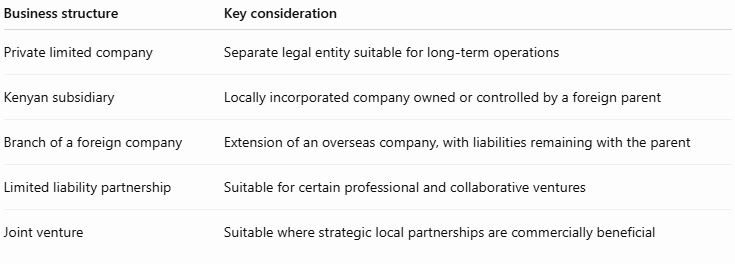
For many international businesses, establishing a Kenyan subsidiary offers an effective structure for managing operational risks, establishing local contracts, recruiting employees and building a long-term market presence.
However, selecting between a subsidiary and a branch should involve an evaluation of taxation, liability exposure, funding requirements, profit repatriation and the investor's broader international business strategy.
4. How to register a company in Kenya as a foreign investor
Company registration in Kenya is administered by the Business Registration Service (BRS), primarily through the eCitizen platform.
The registration process generally involves:
- Selecting the proposed company name.
- Determining the shareholders and directors.
- Establishing the share capital and ownership structure.
- Preparing the incorporation documents.
- Providing identification and beneficial ownership information.
- Submitting the registration application and paying statutory fees.
- Obtaining the Certificate of Incorporation.
Foreign corporate shareholders may also need to provide parent company incorporation documents, corporate resolutions and ownership information.
The documentation requirements may vary depending on the company's ownership structure and intended business activities.
How much does company registration cost in Kenya?
The Business Registration Service publishes the following standard registration fees in 2026:
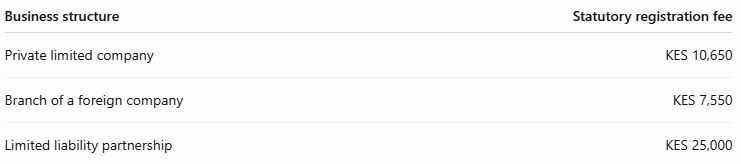
These fees exclude professional advisory charges, document authentication, business permits, immigration costs and sector-specific licensing requirements.
Although incorporation can be relatively straightforward, investors should distinguish between registering a company and obtaining the necessary approvals to commence business operations.
5. Minimum capital requirements for foreign investors
A common misconception is that every foreign investor must invest USD 100,000 to register a company in Kenya.
While ordinary private company incorporation does not generally require this level of investment, the USD 100,000 threshold applies to certain foreign investment facilitation and immigration requirements.
For example, foreign investors seeking an Investment Certificate through the Kenya Investment Authority (KenInvest) generally need to demonstrate a qualifying investment of at least USD 100,000. Read more on Kenya Investment Authority https://www.investkenya.go.ke/.
Similarly, foreign entrepreneurs seeking a Class G business or consultancy permit are generally required to provide evidence of investment capital of at least USD 100,000.
These requirements should be considered separately from company incorporation.
Investors should develop a capital structure that reflects their operational funding requirements, regulatory obligations and long-term business plans.
6. Tax registration and compliance in Kenya
Understanding Kenya's taxation framework is essential for foreign businesses.
Following incorporation, a company must obtain the relevant Kenya Revenue Authority (KRA) registration and assess its applicable tax obligations.
These may include:
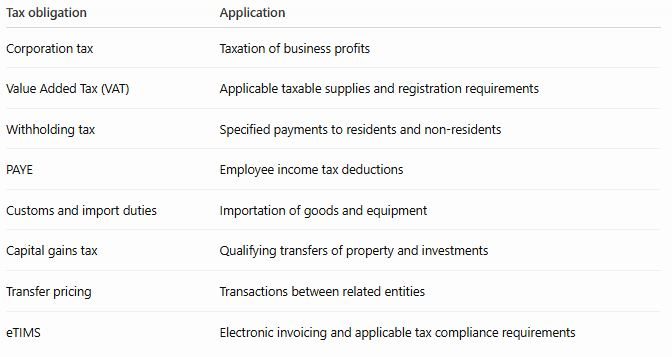
Read more on Taxes in Kenya https://www.kra.go.ke/.
Foreign investors should pay particular attention to cross-border transactions involving:
- Management and consultancy fees
- Royalties and software licensing
- Intercompany loans and interest
- Dividends and profit repatriation
- Shared administrative expenses
- Transactions between parent companies and subsidiaries
International tax planning should begin before the first transaction takes place, rather than after the company receives a tax assessment. An appropriate structure can help investors manage double taxation exposure, withholding tax costs, transfer pricing risks and potential permanent establishment obligations.
7. Business permits, work permits and regulatory approvals
Company registration does not automatically authorize a foreign national to work in Kenya.
Depending on the proposed activities, investors may require:
- County government business permits
- Sector-specific operating licences
- Work or investor permits
- Environmental and health approvals
- Import and export registrations
- Data protection registration, where applicable
- Professional or industry-specific approvals
The applicable immigration permit should be determined based on whether the foreign national is an investor, employee, consultant or specialist.
Establishing a regulatory compliance roadmap before commencing operations can significantly reduce unnecessary delays and operational disruptions.
8. Opening a corporate bank account and funding the business
Foreign-owned companies must also establish appropriate banking and financing arrangements.
Financial institutions generally require company incorporation documents, tax registration details, identification documents, beneficial ownership information and evidence of the source of funds.
Beyond opening a bank account, investors should determine how the company will be financed.
Common financing arrangements include:
- Share capital contributions
- Shareholder loans
- Intercompany financing
- Local bank financing
- External investment capital
The choice between equity and debt financing may have implications for taxation, interest deductibility, foreign exchange exposure, cash flow and profit repatriation.These decisions should be properly documented and supported by a comprehensive financial plan.
9. Employment, payroll and statutory compliance
Foreign companies employing staff in Kenya must comply with local employment legislation and statutory payroll requirements.
Key obligations include:
- Employment contracts and personnel records
- Pay As You Earn (PAYE)
- National Social Security Fund (NSSF)
- Social Health Insurance Fund (SHIF) contributions
- Affordable Housing Levy
- Applicable workplace insurance requirements
- Other employer-specific statutory obligations
Implementing an effective payroll and human resource compliance framework from the beginning protects the company against penalties, employment disputes and reputational risks.
Also read https://optima-accounting.co.ke/blog/payroll-statutory-deductions-in-kenya-2026.
10. Establishing a strong financial management framework
One of the most underestimated aspects of entering a new market is establishing an effective financial management system.
International businesses often focus heavily on registration, licensing and commencing operations while overlooking the systems necessary to monitor financial performance.
A well-structured Kenyan operation should establish:
- A reliable accounting and bookkeeping system
- Financial policies and internal controls
- Monthly management accounts
- Budgeting and cash flow forecasting
- Tax compliance calendars
- Financial reporting to overseas shareholders
- Statutory financial statements and audit readiness
- Intercompany reconciliation and reporting procedures
For foreign-owned subsidiaries, timely and accurate financial reporting is particularly important because overseas management may have limited visibility into daily local operations.
An outsourced accounting or fractional CFO arrangement can provide international businesses with professional financial oversight without immediately establishing a full internal finance department.
11. Common mistakes foreign investors make when entering Kenya
The greatest risks in international market entry often arise after company registration.
Common mistakes include:
- Selecting a business structure without considering tax implications.
- Underestimating working capital requirements.
- Commencing operations without the necessary licences.
- Deploying foreign personnel without appropriate immigration approvals.
- Failing to document intercompany transactions.
- Underestimating payroll and employment compliance costs.
- Neglecting beneficial ownership and statutory annual filings.
- Establishing inadequate accounting and internal control systems.
- Assuming that tax and regulatory practices in their home country apply in Kenya.
Many of these risks can be addressed through appropriate pre-investment planning and professional local advisory support.
12. Developing a successful Kenya market entry strategy
A sustainable market entry strategy should address four critical areas:
Commercial viability: Is there sufficient market demand to justify the investment?
Regulatory readiness: Has the business identified and obtained all necessary approvals?
Financial sustainability: Does the investment have adequate capital, realistic projections and sufficient working capital?
Operational governance: Are there appropriate accounting, compliance, reporting and internal control systems?
Successful foreign investment depends on the integration of these four areas, not simply completing the company registration process.
13. How Optima Accounting & Advisory supports foreign investors
At Optima Accounting & Advisory, we help international businesses navigate the complexities of establishing and managing operations in Kenya. We hve partnered with legal experts to make your entry to Kenyan business environment seamless.
Our business advisory and market entry support services include:
- Pre-investment financial and regulatory advisory
- Business structure and tax planning
- Company registration support
- Kenyan subsidiary setup
- Tax registration and compliance
- Business plans and financial feasibility assessments
- Financial modelling and cash flow projections
- Outsourced accounting and bookkeeping
- Payroll and statutory compliance
- Fractional CFO and financial management services
- Management reporting for overseas shareholders
- Financial reporting and audit readiness support
- Coordination with relevant legal, immigration and licensing professionals
Our objective is to help foreign investors establish businesses that are not only legally registered but also financially sustainable, compliant and positioned for growth.
Frequently asked questions about setting up a company in Kenya
Can a foreign company open a subsidiary in Kenya?
Yes. An overseas company can incorporate a Kenyan subsidiary and generally hold all its shares, subject to applicable sector-specific requirements.
Does a foreign investor need a Kenyan business partner?
Not generally. However, certain regulated industries may have ownership or licensing conditions.
How long does company registration take in Kenya?
The Business Registration Service indicates a standard processing period of approximately three to five days for private limited companies and foreign branches. Banking, tax registration, licensing and immigration approvals may extend the overall setup timeline.
Can I register a company in Kenya without living in Kenya?
Generally, yes. Foreign investors can establish a Kenyan company without being personally resident in Kenya, subject to identification, incorporation and applicable regulatory requirements.
Do I need a work permit to own a company in Kenya?
Share ownership alone does not automatically require a work permit. However, actively working in or managing the business while physically present in Kenya may require appropriate immigration authorization.
Can foreign investors outsource accounting and payroll in Kenya?
Yes. Outsourcing accounting, payroll, taxation and financial management can help international companies maintain compliance while reducing the cost of establishing an internal finance department.
Conclusion: Invest in Kenya with confidence
Kenya offers compelling opportunities for foreign investors seeking to establish and grow businesses in East Africa.
However, a successful investment requires more than identifying a promising market or registering a company. It requires deliberate financial planning, effective governance, regulatory compliance and a clear understanding of the local business environment.
With the right professional support, international investors can reduce market entry risks, strengthen financial oversight and establish a platform for sustainable regional growth.
Are you planning to establish a company, subsidiary or business operation in Kenya?
Contact Optima Accounting & Advisory to discuss your investment plans, company setup requirements, tax obligations and ongoing financial management needs.
Build your business in Kenya on the right financial and regulatory foundation.
Disclaimer: This article provides general business and regulatory information and does not constitute specific legal or tax advice. Requirements may vary depending on the industry, ownership structure and prevailing legislation.
Have a question about this?
Our accountants can look at your specific situation.